
Fishing with Friends - Part 1
Fishing with Friends
By the time Adrian and I met at the River Lugg early on a Saturday morning in mid-May, we'd already spent the better part of a week fishing it in our heads, or at least I had. The Danica hatch was on, apparently. Like most anglers, we become amateur meteorologists in the days leading up to the trip, studying weather forecasts with a level of concentration we rarely apply to anything genuinely important. Every warm afternoon was encouraging, every freezing cold night a potential disaster. Water temperatures had been discussed at length, along with river levels, hatch timings, and fly patterns. By the time I finally pulled into the car park, it felt less like the start of a fishing trip and more like the culmination of a campaign.
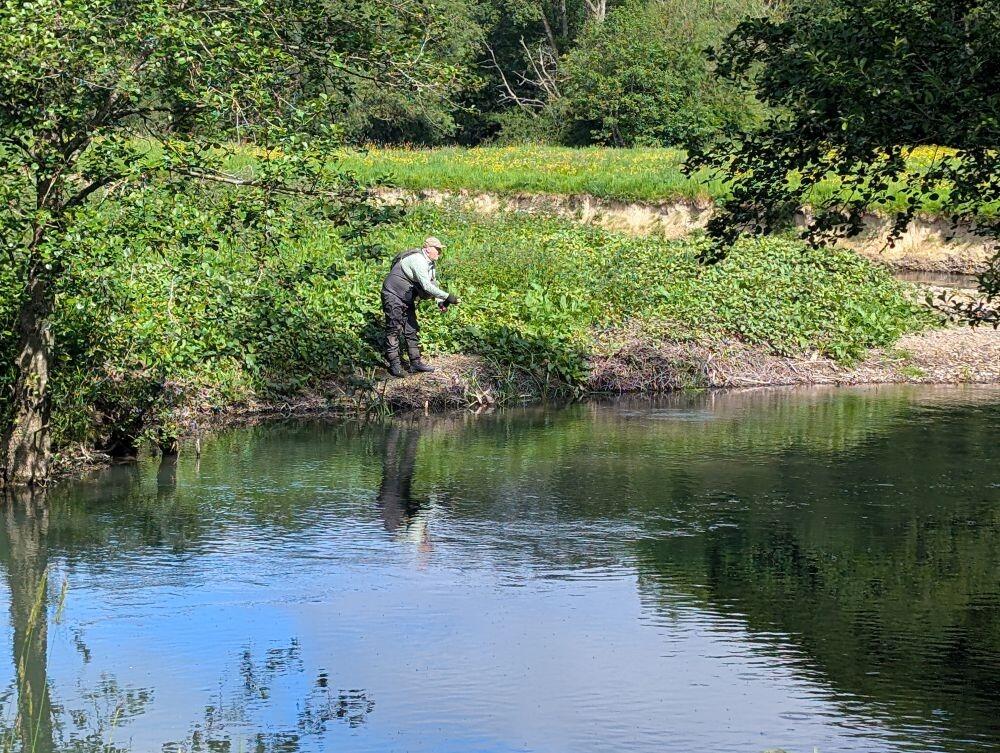
The river looked magnificent under cloudless blue skies but the temperature was rocketing upwards.
Spring had settled properly into the Herefordshire countryside. The hedgerows were thick with fresh green growth, hawthorn blossom brightened the field margins, and the meadows bordering the river seemed almost unnaturally vibrant in the morning sunshine. As I drove up the access track, I could see the river and it carried that perfect late-spring clarity that encourages optimism in fishermen. It wasn't gin clear, I'm not sure it ever is, but clear enough that you could read the currents, pick out the runs, and imagine fish stationed behind every likely seam. The water slid beneath overhanging willows and curled around gravel bars with effortless grace. Rivers always seem patient to me. They have nowhere urgent to be and no interest whatsoever in our expectations.
We stood beside the cars for a few minutes eating bacon baguettes and finishing our flat whites before assembling the rods. Partly because there was no rush and partly because, after all the anticipation, it seemed worth taking a moment simply to be there. One of the mistakes many anglers make is treating the journey to the river as an inconvenience rather than part of the experience.
I'd set off at about six o'clock that morning and driven through towns and villages that seemed almost deserted. There were few signs of life to spoil the tranquillity of the drive and, for once, even the traffic appeared to be enjoying a lie-in.
On one stretch of B-road that Waze had thoughtfully selected for me, I found myself bumper-to-head with a young and rather frisky Holstein Friesian that had somehow become separated from the herd. With its newfound freedom it had transformed itself into a bucking bronco, bouncing up and down the road and kicking out its hind legs with complete indifference to any damage it might cause. It seemed to be enjoying its brief taste of independence far more than the motorists behind it.
Another driver stopped to help and, between us, we eventually persuaded the cow through a gate and into a very green and entirely empty pasture. It would certainly have a good feed, albeit a lonely one. As delays to a fishing trip go, it was infinitely preferable to a traffic jam and considerably more memorable.
We spend hours dreaming about being beside the water, only to arrive and immediately start hurrying. Age, if it has taught me anything useful, has taught me to slow down at the beginning of a fishing day.
"Looks fishy," I said eventually as we looked at what turned out to be the 'banker pool' for the day alongside the access track.
"Looks fishy" may be the most used phrase in angling, and possibly the least informative. Given enough enthusiasm, anglers can convince themselves that almost any body of water looks fishy. I'm sure I've seen anglers stare hopefully into drainage ditches believing it must hold fish, I do it all the time. Yet, on this occasion the observation happened to be accurate. Everything about the river suggested possibility. There were long glides where some trout might intercept drifting mayflies, shaded lies beneath the trees, and deep pools that hinted at larger fish. Whether any trout intended to cooperate was another matter entirely.
The first hour passed much as the first hour often does on a highly anticipated fishing trip. We fished hard, moved frequently, and caught absolutely nothing. This didn't concern us. At least not immediately. Hope is one of the most resilient qualities anglers possess. It survives evidence that would crush most other forms of optimism. Every empty run simply meant the next one might hold a fish. Every unanswered cast merely increased the likelihood that success waited around the next bend.
Besides, there was plenty to look at. Swallows skimmed low across the river. A grey wagtail worked methodically along the far bank, dippers bounced and some unidentified raptor soared high above us. The occasional mayfly drifted past, enough to reassure us that we hadn't completely misjudged the timing. Not many yet, but enough. The great Danica hatch is one of the annual events that gives structure to a fly fisher's calendar. Christmas comes and goes. Birthdays arrive with increasing frequency. But mayfly season remains one of the fixed points around which the year revolves.
Around midmorning the river began to change.
The first signs were subtle. A few more mayflies appeared above the water, fluttering awkwardly through the sunlight. Then we noticed a rise beneath an overhanging willow. A few minutes later another trout showed farther upstream. The river suddenly seemed more alive. Not dramatically so, just enough to sharpen our attention. We stopped talking quite so much and started watching more carefully.
There's a particular excitement associated with the beginning of a hatch. It feels less like observing nature and more like witnessing the opening moments of a performance. The actors are taking their places, the audience is becoming attentive, and everyone senses that something is about to happen. The trout certainly seemed aware of it. Rises began appearing intermittently throughout the stretch, some subtle and deliberate, others confident enough to leave no doubt about what the fish were feeding on.
Adrian spotted the first truly interesting fish. It was feeding steadily beneath a line of branches on the far bank, rising every few minutes with the sort of consistency that encourages poor decision-making in anglers. A fish that rises consistently can be admired; a fish that rises intermittently becomes a challenge.
We watched it for several minutes.
"Good fish," Adrian said quietly.
Of course, every trout looks larger before it's hooked than afterwards. That's another immutable law of fishing. Nevertheless, this appeared to be a respectable brown trout, feeding confidently and apparently unaware of our presence. Adrian eased into position and stripped line from the reel with the careful concentration that experienced anglers adopt when trying not to think too much.
His cast landed a few feet above the rise and the fly drifted naturally downstream. For a moment nothing happened. Then the trout appeared beneath the surface and took the fly with surprising confidence. The strike was immediate and so was the chaos.
The fish tore downstream, making it abundantly clear that it had no intention of participating willingly. From where I stood, safely uninvolved in the actual battle, it looked magnificent. It's always easier to appreciate a fish's athleticism when it isn't attached to your own rod. Adrian moved carefully through the shallows, trying to maintain pressure while avoiding the various obstacles that rivers thoughtfully provide for escaping trout.
Many seconds, possibly minutes later, he slid the net beneath a beautifully marked brown trout. It wasn't enormous, nor was it the sort of fish that generates magazine covers or exaggerated stories. It was simply a perfect wild trout from a small river during a mayfly hatch, and in many ways those are the best kind.
By now the temperature had climbed considerably, so we did the sensible thing and retreated to the pub. Sitting beneath an umbrella with cold pints of the local brew in front of us, we replayed the morning's events and made plans for the afternoon session. As every angler knows, fishing strategies always seem far more convincing after a pint…TBC