Handcrafted Wooden Fly Rod Reel Seat Inserts | The Woods We Use | Fortitude Rod Co
From Timber to Reel Seat — Part One: The Wood
Exploring the origins, character and natural beauty of the timbers used in our handcrafted wooden reel seat inserts.
There is something rather special about a beautifully figured piece of wood. The colours, grain patterns and natural imperfections tell a story that has often taken decades, sometimes centuries, to develop. No two pieces are ever quite the same, and that individuality is one of the reasons we enjoy working with timber at Fortitude Rod Co.
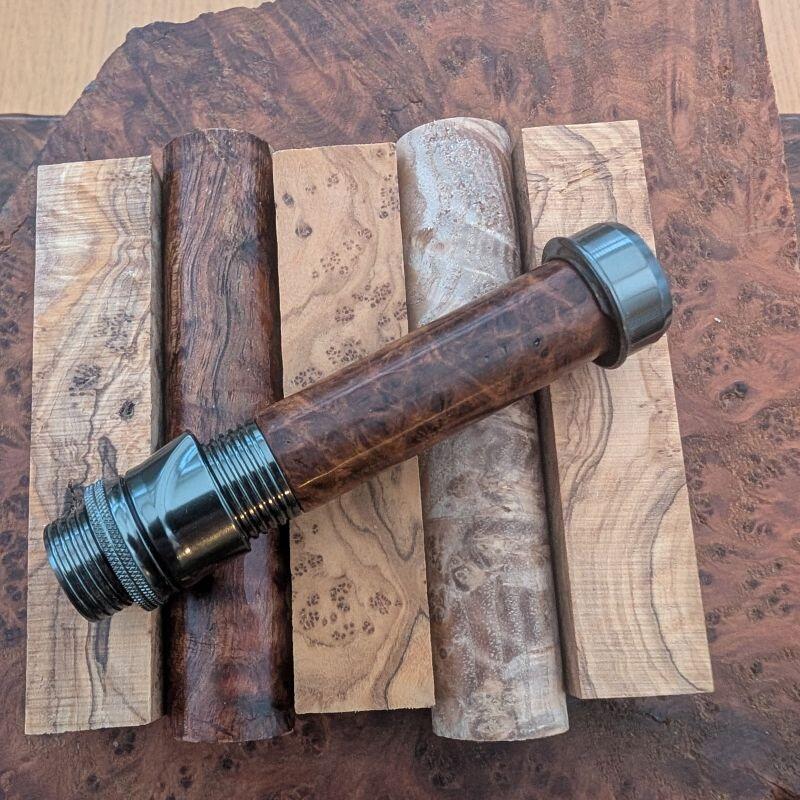
A wooden reel seat insert might be one of the smaller components on a fly rod, but it can have a considerable influence on the character of the finished build. Whether it's the understated warmth of English Walnut Burr, the intricate eyes of Amboyna Burl or the dramatic contrasting grain of Bocote, the choice of timber can turn an otherwise functional component into something quite distinctive.
In this first instalment of our three-part series, we'll look at the woods we use, where they originate, what makes them desirable and how we select the timber that will eventually become a Fortitude reel seat insert.
What Makes a Piece of Timber Special?
Much of the timber we use is selected for its figure rather than simply its colour or species. Figure describes the patterns created by the way the wood fibres grow, often producing swirls, ripples, eyes and contrasting grain that become particularly apparent once the timber has been turned and polished.
Burrs, also known as burls, are among the most desirable examples. These unusual growths develop on trees when normal growth patterns are disrupted, often producing clusters of dormant buds and highly irregular grain. The resulting timber can contain extraordinary patterns that would never appear in ordinary straight-grained wood.
Because burrs are unpredictable, their quality and value can vary enormously. A large burr may yield only a relatively small quantity of timber suitable for precision turning, particularly when natural cracks, voids or areas of unsound wood are taken into account.
For us, the attraction lies in finding those individual sections where colour, figure and grain combine to produce something exceptional.
British Burrs — Character Close to Home
Some of our favourite woods are found much closer to home.
English Walnut Burr is a particularly beautiful timber, ranging from warm chocolate browns to lighter golden tones, often with complex swirling grain and tightly clustered burr eyes. Highly figured Walnut has long been prized by cabinetmakers, gunstock makers and decorative woodturners, and good-quality burr material can command a considerable premium over ordinary Walnut.
English Oak Burr has a different character altogether. Oak is familiar to most of us, but burr Oak can be remarkably intricate, with rich golden-brown colouring, irregular grain and striking patterns of small eyes. Its association with traditional British craftsmanship makes it an especially appealing choice for a handcrafted fly rod.
Elm Burr is another favourite. Its warm reddish-brown colouring and distinctive clusters of eyes can produce some of the most attractive patterns of any native timber. Large, sound and heavily figured pieces are particularly sought after.
Birch Burr we are a huge fan of Scottish Silver Birch Burr, a wood that needs stabilising which not only gives us a stable turning piece but enhances the incredible figure found in this wood.
These British timbers offer something beyond appearance. There is a certain satisfaction in building a fly rod using wood that may have grown in the same countryside where the rod will eventually be fished.
Exotic Burls — Nature at Its Most Extravagant
Moving further afield, some of the world's most spectacular decorative timbers come from tropical forests and the dry landscapes of Australia and North Africa.
Amboyna Burl, associated with the Narra tree (Pterocarpus indicus) of Southeast Asia, is among the most highly prized decorative burls. Its rich red, orange and golden colours, combined with tightly packed eyes and swirling grain, can be extraordinary. Exceptional examples are expensive, reflecting both their rarity and the demand for highly figured material.
Afzelia Burl (Afzelia xylocarpa) originates from Southeast Asia, particularly Thailand, Laos, Cambodia, Vietnam and Myanmar. The timber is prized for its rich golden-orange to reddish-brown colouring, density and durability. Highly figured burr examples can display intricate swirling grain and clusters of eyes, making them particularly desirable for decorative woodturning. The finest pieces are relatively scarce and can command premium prices, especially when the figure is pronounced and the timber is free from significant defects.
Thuya Burr (Tetraclinis articulata) comes principally from Morocco, where the characteristic burr material is associated with growth around the roots and base of the tree. Its rich golden-brown colouring, often with a reddish cast, is complemented by dense clusters of small, dark eyes. Thuya has been valued for generations by decorative woodworkers, and the finest examples are highly desirable.
From Australia, we use both Red Mallee and Brown Mallee Burl. These burls develop on certain species of Eucalyptus growing in the country's drier regions. Red Mallee typically offers rich reddish-brown colouring, while Brown Mallee displays warmer shades of brown, tan and caramel. Both can exhibit exceptionally dense clusters of burr eyes and dramatic grain patterns.
The appeal of these timbers is their unpredictability. Even two inserts turned from the same larger burr can have completely different appearances.
Spalted Timbers — Beauty Created by Nature
Not all attractive grain patterns are the result of unusual tree growth.
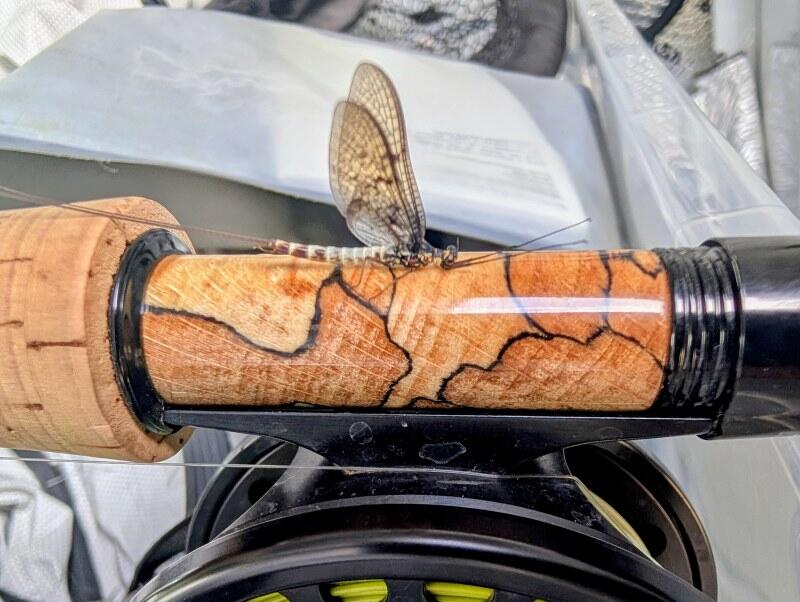
Spalted Chestnut and Spalted Beech develop their distinctive appearance through fungal activity within the timber. As different fungi colonise the wood, they can create dark boundary lines, changes in colour and intricate patterns that are sometimes reminiscent of a landscape drawn in miniature.
The results can be remarkable. Beech, in particular, provides a beautiful background for the dark, wandering lines associated with spalting.
However, spalting presents challenges. The same fungal activity that creates these patterns can also weaken the timber if decay progresses too far. Selecting suitable material requires careful examination, and some pieces benefit from resin stabilisation before turning.
The objective is to retain the character created by nature while ensuring the finished insert is suitable for use on a working fly rod.
Highly Figured Hardwoods — Colour, Contrast and Grain
Alongside our burrs and spalted woods, we use several distinctive hardwoods selected for their natural colour and grain.
Karelian Birch, sometimes known as Masur Birch, is associated particularly with Finland and other parts of northern Europe. Its pale background is interrupted by unusual dark, curled and mottled figure. The characteristic pattern occurs in only a small proportion of Birch trees, making genuine, strongly figured material relatively scarce and valuable.
Olivewood, principally associated with the Mediterranean region, is instantly recognisable by its golden colouring and flowing dark brown grain. Particularly figured examples can produce beautiful reel seat inserts, with a warmth and natural character that works especially well alongside traditional rod-building materials.
Buckeye Burl, originating from western North America, offers an entirely different palette. Cream, grey, blue-grey and darker contrasting areas can occur within the same piece. Its unusual colouring makes it highly desirable, although its relatively soft and sometimes porous structure means that selected pieces benefit considerably from stabilisation.
Namibian Rosewood, commonly associated with Guibourtia coleosperma, is a dense, attractive southern African hardwood with warm reddish-brown colouring and darker grain. Despite its common name, it is not a true Rosewood of the Dalbergia genus. Its natural density and attractive finish make it a particularly suitable choice for reel seat inserts.
Finally, Bocote, originating from Mexico and Central America, is one of the most visually distinctive timbers we use. Its golden-yellow to brown background is interrupted by dramatic dark brown and almost black grain patterns. Dense, naturally lustrous and capable of taking a beautiful polish, Bocote can make an exceptionally striking insert.
Why Are Some Woods So Valuable?
The value of decorative timber is influenced by several factors, including rarity, demand, colour, figure, size and condition.
A heavily figured burr with tightly packed eyes will generally command a higher price than a relatively plain piece of the same species. Large, sound pieces can be especially valuable because irregular growth often introduces cracks, bark inclusions and voids that reduce the amount of usable material.
Origin and availability also play a part. Some exotic burls are produced in limited quantities, while highly figured examples of more familiar species may be relatively uncommon.
However, expensive timber does not automatically make a better reel seat insert. A beautifully figured piece must also be structurally suitable, capable of being accurately machined and able to withstand the demands of regular fishing.
In many cases, the skill lies in recognising the potential of a particular piece rather than simply choosing the most expensive wood.
Selecting Our Timber at Fortitude
At Fortitude Rod Co, we source our timber in larger pieces rather than purchasing ready cut reel seat-sized blanks.
This gives us greater control over the selection process and allows us to examine the grain, colour and figure before deciding how best to cut each piece.
With highly figured timber, the direction of the cut can make a considerable difference to the final appearance. A slight change in orientation can reveal an entirely different pattern, particularly in burrs where the grain twists and changes direction over very short distances.
Working with larger pieces also allows us to select the most suitable areas while avoiding significant cracks, voids or other defects wherever possible.
Of course, not every section of an attractive piece of timber will be suitable. Some of the most spectacular-looking areas can also be the most difficult to work with, and there is often a balance to be struck between appearance and structural integrity.
This initial selection is an important part of the process, long before any turning begins.
Resin Stabilisation — Making the Most of Natural Timber
Not all woods possess the same natural hardness, density or stability.
Some of the softer burls and spalted timbers we use can benefit from resin stabilisation, a process we carry out inhouse at Fortitude.
Using a specialist resin treatment, suitable prepared timber is impregnated with resin before being heat cured. This can improve hardness, reinforce porous areas and make certain delicate woods more suitable for precision turning.
It is not a process that every timber requires. Naturally dense woods such as Bocote, Thuya and some of the other hardwoods we use are often suitable without treatment, depending on the condition of the individual piece.
Each piece is assessed individually, with the aim of preserving its natural beauty while producing a reliable, practical component.
We'll explore the stabilisation process in more detail in Part Two of this series.
Every Insert Has Its Own Character
One of the most rewarding aspects of working with natural timber is that no two reel seat inserts are ever identical.
Even when several inserts are produced from the same piece of wood, differences in grain, colour and figure ensure that each has its own character.
For some rod builders, the attraction is a subtle, traditional timber such as English Walnut Burr or Olivewood. Others prefer the dramatic figure of Amboyna, Thuya or Mallee Burl, while the unusual colours of Buckeye or the intricate patterns of spalted Beech offer something quite different.
Whatever the choice, we believe the timber should complement the rod rather than simply decorate it.
And while the finished insert may be small, a great deal of consideration goes into selecting the wood from which it is made.
Coming Next — Part Two: From Rough Timber to Reel Seat Insert
In the next instalment, we'll move into the Fortitude workshop to look at how we cut and prepare our timber, stabilise selected woods and turn the blanks to the precise dimensions required for our reel seat hardware.