
Sanded vs Unsanded Fly Rod Blanks: What’s the Difference?
Sanded vs Un-sanded Fly Rod Blanks – What’s the Difference?
The difference between a sanded and un-sanded fly rod blank is primarily the way the outside of the blank is finished after curing. An un-sanded blank retains the fine spiral ridges created by the wrapping tape used during manufacture, while a sanded blank has these ridges mechanically reduced or removed to produce a smoother surface.
The same basic distinction applies to both fibreglass and carbon fibre fly rod blanks.
Neither method automatically produces a better-performing blank. The action and performance of a fly rod blank are influenced far more by its taper, material, wall thickness, fibre orientation and overall laminate design than by whether its exterior has been sanded.
For the rod builder, however, there are some differences worth understanding – particularly when preparing the blank for guides, thread wraps and epoxy finish.
How is a fly rod blank made?
Although the materials differ, most tubular carbon fibre and fibreglass rod blanks are manufactured using broadly similar principles.
Sheets of resin-impregnated reinforcement material, known as prepreg, are cut to carefully designed patterns and rolled around a tapered steel mandrel. The shape of these patterns, together with the mandrel profile, material and fibre orientation, helps determine the finished blank’s taper, power and action.
The rolled material is then tightly wrapped with heat-resistant tape before being cured. This wrapping applies pressure during curing, helping to consolidate the laminate against the mandrel.
Once curing is complete, the blank is removed from the mandrel and the wrapping tape is stripped away.
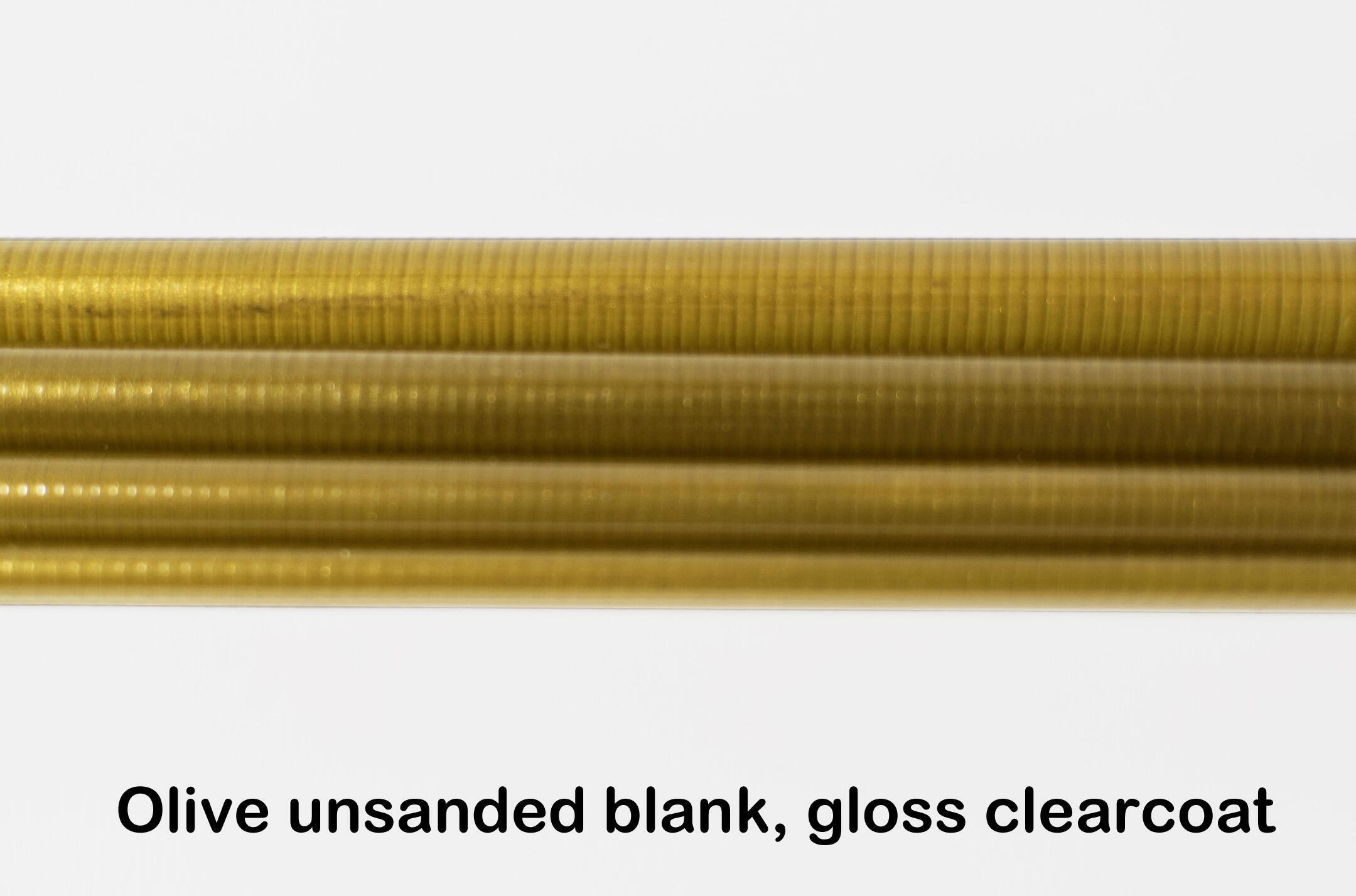
The tape leaves a characteristic fine spiral pattern along the surface of the blank.
What the manufacturer does with this surface next determines whether we describe the finished blank as sanded or un-sanded.
What is an un-sanded fly rod blank?
An un-sanded fly rod blank retains much of the surface texture created during the curing process rather than having the spiral ridges mechanically removed.
Run your fingers along an un-sanded blank and you can usually feel the fine ridges. On a translucent fibreglass blank they can also be clearly visible and have become part of the distinctive appearance associated with many modern glass rods.
Leaving the blank un-sanded avoids mechanically removing material simply to create a perfectly smooth exterior. It also eliminates the possibility of the sanding process unnecessarily cutting into the structural fibres beneath the resin-rich surface.
That doesn’t mean an un-sanded blank is automatically stronger or better. Blank performance depends much more heavily on the design and construction of the laminate than on its final surface texture.
It is also important to understand that an un-sanded blank isn’t an unfinished blank. The visible spiral is simply a characteristic of the manufacturing process that has deliberately been retained.
What is a sanded fly rod blank?
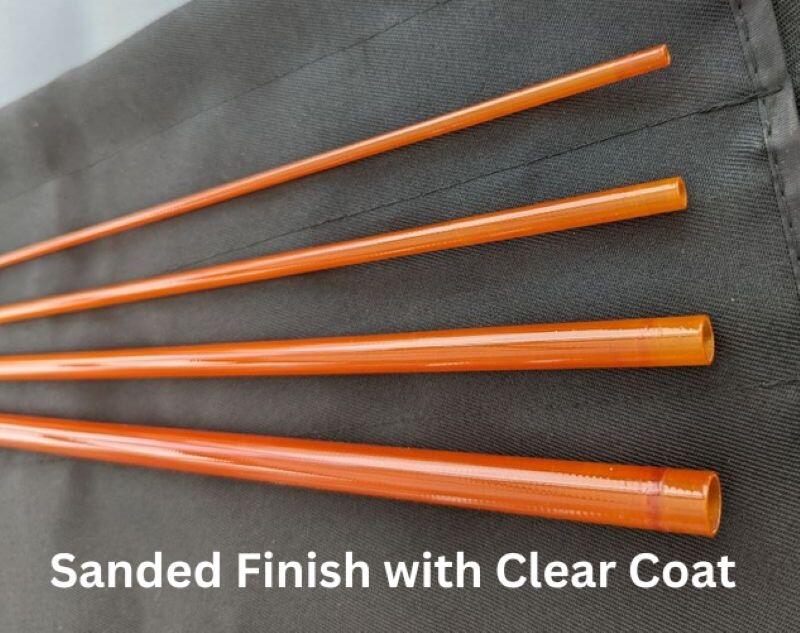
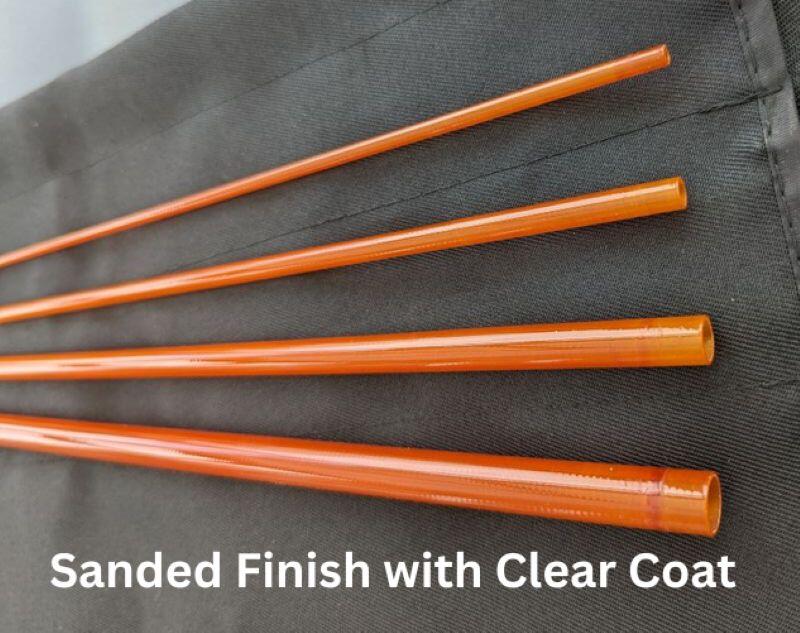
A sanded fly rod blank undergoes an additional finishing operation after it has been cured, removed from the mandrel and had the wrapping tape stripped away.
The purpose is to reduce or remove the raised spiral ridges and create a smooth, consistent exterior.
This isn’t normally a case of simply taking abrasive paper to the blank by hand. In commercial rod blank production, the blank is typically rotated while being passed against or through a controlled abrasive sanding system. Depending on the manufacturer and equipment being used, abrasive belts, wheels or other purpose-designed sanding machinery may be employed.
Because a fly rod blank is tapered, the process has to accommodate the changing diameter from butt to tip. The amount of material removed must also be carefully controlled.
The objective is to remove the raised, resin-rich surface produced by the wrapping process rather than significantly alter the structural laminate beneath it.
Several progressively finer abrasive stages may be used to achieve the required finish. Once the spiral ridges have been reduced or removed, the blank has the smooth and uniform surface normally associated with a sanded rod blank.
Too little sanding can leave an inconsistent surface; too much risks exposing or damaging the reinforcement fibres beneath the resin-rich exterior. With thin-walled, lightweight fly rod blanks, this control is particularly important.
The finished blank may then be left with a natural appearance or receive additional cosmetic finishing such as paint, pigment or a clear coat, depending on the manufacturer.
Can both fibreglass and carbon fibre fly rod blanks be sanded?
Yes. Both fibreglass and carbon fibre fly rod blanks can be manufactured with sanded or un-sanded surfaces.
The terms describe the treatment of the exterior of the blank after curing rather than the type of reinforcement material used to make it.
The distinction is particularly noticeable with fibreglass fly rod blanks.
Modern E-glass and S-glass blanks are available with finishes ranging from smooth painted surfaces to distinctly visible un-sanded spiral finishes. With translucent glass, the combination of the underlying fibres, resin and manufacturing texture can create a particularly attractive appearance.
Carbon fibre blanks can also retain some manufacturing texture, although the visual effect is different because carbon fibre is opaque.
Does sanding change the action of a fly rod blank?
Not to any meaningful extent in isolation.
Sanding removes a small amount of material and therefore theoretically changes the mass of the blank. However, it would be misleading to assume that a sanded blank will inherently be lighter, faster or more sensitive than an un-sanded blank.
The characteristics of a fly rod blank are determined primarily by its taper, wall thickness, material, fibre orientation, resin system and overall laminate design.
For this reason, sanded versus un-sanded should primarily be considered a manufacturing and surface-finish choice rather than an indication of the quality or performance of a fly rod blank.
How should you prepare a sanded blank for building?
A smooth blank makes guide positioning and thread wrapping relatively straightforward.
Before starting the build, clean the blank with a clean, lint-free cloth to remove dust, grease and other contamination. Avoid aggressive solvents unless specifically approved by the blank manufacturer, particularly with painted or clear-coated blanks.
Guide preparation is equally important. Each guide foot should have a smooth, gradual transition so the wrapping thread can climb easily from the blank onto the guide without bunching or leaving gaps.
There is no reason to sand the blank beneath the guide wraps.
Doing so can damage the manufacturer’s surface finish and, more importantly, risks unnecessarily removing material from the blank itself.
How should you prepare an un-sanded blank for guides and epoxy?
The same basic rule applies to an un-sanded blank: don’t sand the blank simply to make the surface smooth beneath the guide wraps.
The spiral ridges are part of the blank’s surface and can be wrapped over without difficulty.
Good guide-foot preparation becomes particularly important. A properly shaped guide foot with a thin, gradual leading edge helps the thread transition cleanly from the textured blank onto the guide.
When applying rod-building epoxy, the surface texture may remain more apparent around the edges of the wraps than it would on a completely smooth blank.
Apply the finish carefully and allow it to flow naturally into the surface texture rather than trying to compensate by applying an unnecessarily heavy coat.
The aim should be even coverage rather than excessive epoxy build.
Whichever type of fly rod blank you’re building on, cleanliness is important. Clean hands, properly prepared guides, clean thread and a dust-free finishing area will have far more influence on the quality of the finished wraps than whether the blank itself is sanded or un-sanded.
Sanded or un-sanded – which fly rod blank should you choose?
There is no simple answer that makes one inherently better than the other, the important thing for the rod builder is to understand what you’re working with.
An un-sanded blank shouldn’t be viewed as a sanded blank that still needs finishing. Likewise, a smooth sanded blank isn’t automatically an indication of greater quality.
Sanded and un-sanded simply describe two different approaches to the final surface of a fly rod blank.
Frequently asked questions
Are un-sanded fly rod blanks stronger than sanded blanks?
Not necessarily. Avoiding sanding removes the possibility of fibres being damaged during that particular manufacturing stage, but the strength of a blank depends on its complete design and construction. An un-sanded surface alone doesn’t make a blank stronger.
Are un-sanded fly rod blanks lighter?
Not necessarily. Sanding can remove a small amount of surface material, but the finished weight of a blank is determined principally by its materials, dimensions and laminate construction.
Can I sand an un-sanded fly rod blank myself?
It isn’t generally recommended. Manufacturing sanding is a controlled process carried out with knowledge of the blank’s construction and wall thickness. There is normally no reason for a rod builder to remove the spiral ridges before fitting guides.
Do I need to sand a fly rod blank before applying epoxy?
No. The blank beneath and immediately around the thread wraps doesn’t normally need to be sanded before applying rod-building epoxy. Keeping the surface clean and free from contamination is more important.
Is an un-sanded blank unfinished?
No. An un-sanded blank is a finished rod blank where the manufacturer has chosen to retain the characteristic surface texture produced during manufacture rather than mechanically removing it.