
The CRB Advanced Hand Wrapper, why we use it and why you should too.

Why Every Rod Builder Should Be Using the CRB Advanced Hand Wrapper
By Jason Pereira
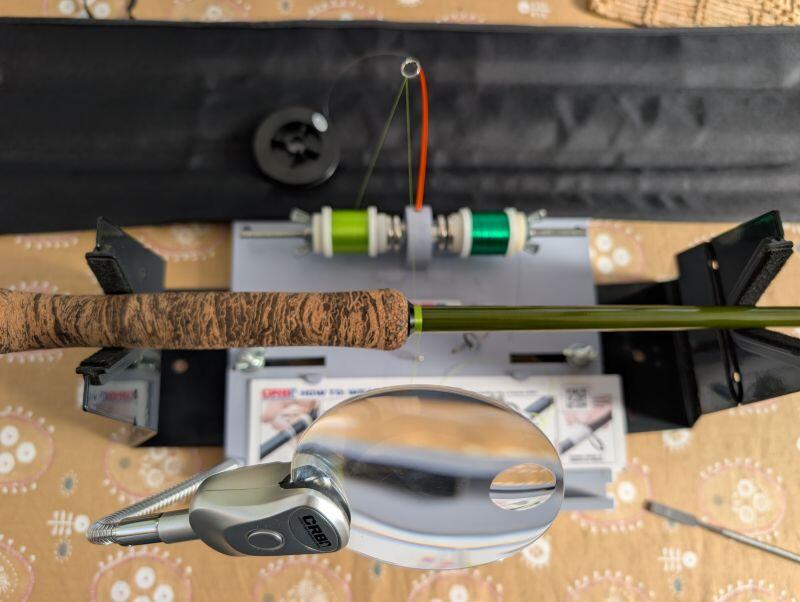
There are some rod-building tools you can improvise.
Many of us probably started wrapping guides with a cardboard box, a couple of V-notches cut into the sides and a book balanced on the thread to provide tension. It works. In fact, you can build a perfectly serviceable fly rod that way.
But once you've built a few rods, you begin to realise that good rod building isn't simply about getting the thread around the blank. It's about control, consistency and repeatability.
And that's where the CRB Advanced Hand Wrapper comes in.
At Fortitude Rod Co, we think it's one of those pieces of equipment that makes sense whether you're building your first rod or your hundredth. For the beginner it removes several unnecessary difficulties from the learning process. For the experienced builder it provides the control needed to produce consistently clean, professional work.
More importantly, it isn't something you necessarily outgrow. With the range of upgrades available, the CRB Advanced Hand Wrapper can develop into a surprisingly capable wrapping station.
Why use a hand wrapper at all?
Wrapping a guide is fundamentally a simple operation: rotate the blank while feeding thread onto it under tension.
Doing it well is slightly different.
The thread needs to lie neatly against the previous turn. Tension needs to remain consistent. The blank needs to remain supported. You need to be able to stop, inspect the wrap, reverse it if necessary and continue without everything suddenly becoming loose.
A good hand wrapper gives you control over all of those things.
Unlike a power wrapper, you determine every rotation of the blank. That makes a hand wrapper particularly well suited to building fly rods, where guide wraps are generally relatively short and precision is more important than speed.
You can stop instantly, reposition a thread, burnish a wrap, check a guide foot or back up a few turns. There is something reassuringly mechanical about it.
Your hands are controlling the rod; the wrapper is helping you control the thread.
The biggest advantage: consistent thread tension
Thread tension is one of the first things a new rod builder has to learn.
Too little tension and the wrap can be loose. Too much and you make wrapping unnecessarily difficult and can potentially fray or snap the thread and make adjusting guide alignment problematic.
More importantly, tension needs to be consistent.
The CRB Advanced Hand Wrapper uses spool-side tension rather than simply dragging the thread between tensioning surfaces. The standard system uses springs and adjustment knobs to control the spool as the thread is fed from it. The design is intended to provide smooth, controlled thread delivery.
That distinction becomes particularly useful when working with different types of wrapping thread. Metallic threads can be susceptible to damage and separation if they're dragged through an unsuitable tensioning system.
Then there's the tension rod
It looks like a relatively insignificant part of the wrapper, but in use it becomes one of its most useful features.
The flexible tension rod acts as a buffer between the spool and the wrap. As you rotate the blank it helps maintain tension on the thread, but it also stores a small amount of thread under tension.
Why does that matter? Because you can stop, inspect your work and reverse the blank a little to remove turns without the thread immediately becoming slack.
For someone learning to wrap guides, that makes the process considerably less intimidating. For an experienced builder, it simply makes working more controlled and efficient.
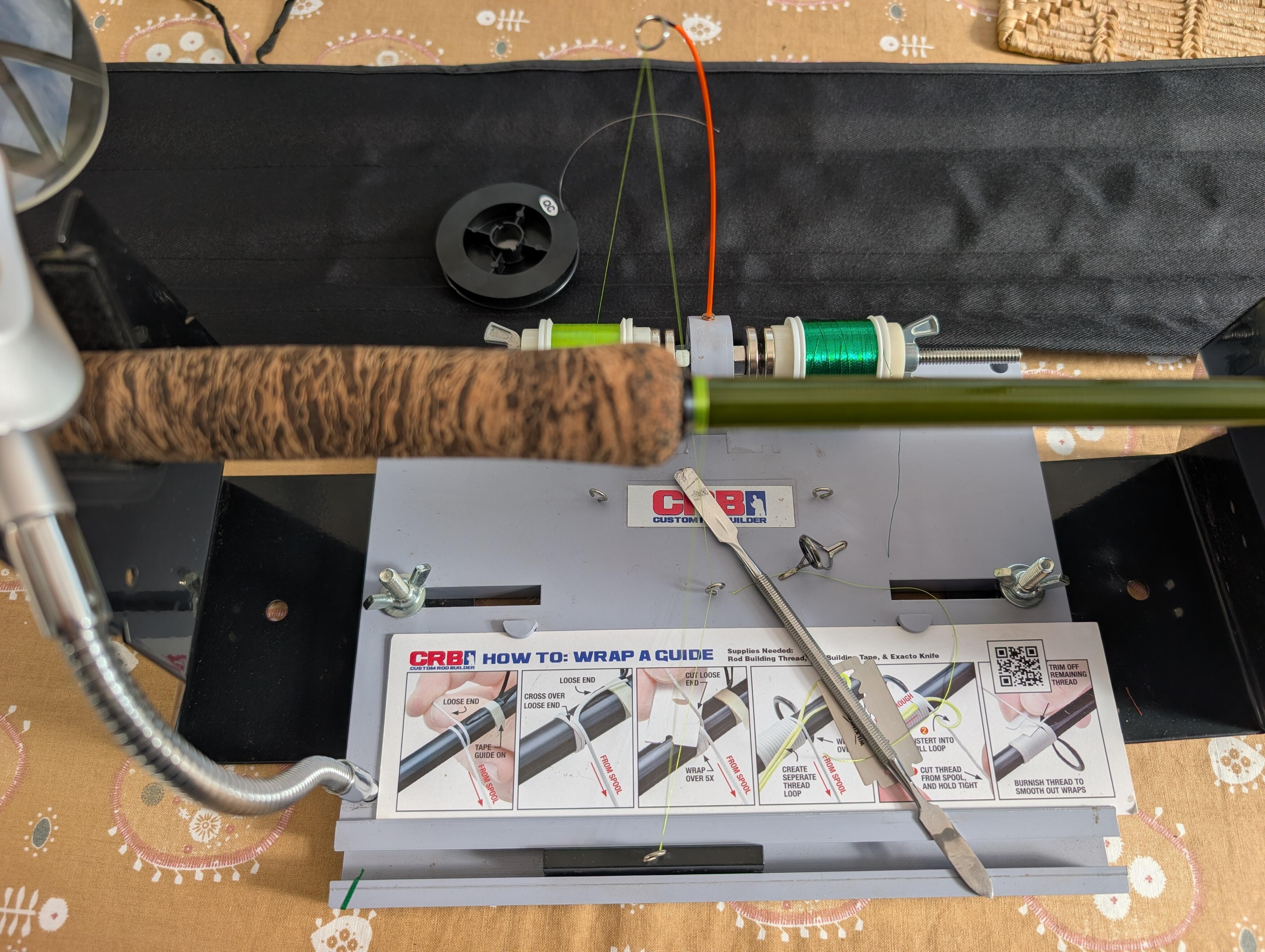
The thread follows the wrap
Another feature is the sliding thread guide built into the base.
As the wrap progresses along the blank, the slider can move with it, allowing the thread to approach the blank from an appropriate position rather than gradually feeding at an increasingly awkward angle.
It's a small detail, but rod building is full of small details. When you're trying to produce parallel turns of fine thread, having the thread sit exactly where you want it makes a noticeable difference.
Proper support for the blank
The Advanced Hand Wrapper also provides adjustable supports for the rod blank. The standard system incorporates the wrapping base plus an additional support that can be positioned to suit the section you're working on. The stands offer several support positions, including provision for larger-diameter rod sections.
For fly rod builders this is particularly useful because you're constantly moving between very different diameters. The tip of a long nymphing blank and the butt section of a heavier fly rod are very different things to work on.
Being able to reposition the supports allows you to keep the section stable while still allowing it to rotate freely. And if you need more support, that's another area where the system can be expanded.
A wrapper for your first rod – not just your first rod
This is probably the most important point.
We regularly speak to people building their first fly rod who understandably don't want to spend money on equipment they don't yet know they'll need. That's perfectly reasonable.
But buying the cheapest possible equipment and then replacing it six months later isn't necessarily the economical option.
In an account published in the Fortitude Journal, first-time builder Ben O'Neill chose a CRB hand wrapper when starting his first builds specifically because it was equipment he could continue using on future rods.
And you don't have to buy every accessory on day one. Start with the standard wrapper, then add to it when your rod building demands it or you think it's a worthy upgrade.
Upgrade 1: Blank Extension Tool
For anyone building multi-piece fly rods, we'd put the CRB Blank Extension Tool right at the top of the list.
Wrapping guides close to the female ferrule end of an individual rod section presents a simple problem: there isn't always enough blank beyond the wrap to sit securely in the wrapper's support.
The CRB Blank Extension Tool provides an elegant solution.
The tapered tool is inserted into the end of the rod section, effectively extending the blank and giving you something substantial to locate in the CRB support stand. It fits blanks with an internal diameter from 0.20" to 0.35", covering a useful range of multi-piece rod sections.
Suddenly, wrapping close to the ferrule becomes considerably easier. Instead of trying to balance a short length of blank beyond the guide wrap, the section is properly supported, allowing it to rotate smoothly while you concentrate on controlling the thread and producing a clean wrap.
But what makes the Blank Extension Tool particularly useful is that its job doesn't finish when the wrapping is complete.
The same Blank Extension Tool is also compatible with the CRB RDS Rod Drying System.
That means you can use it when applying finish to an individual rod section and then use it with the dryer, where the section can rotate while the epoxy cures.
For the fly rod builder, that's a useful piece of workshop equipment. A single inexpensive tool helps solve two awkward stages of working with multi-piece rods: wrapping close to the ferrule and drying the finished wrap afterwards.
It's simple, but that's often what the best rod-building tools are. For anyone using the CRB Advanced Hand Wrapper alongside a CRB rod dryer, we'd consider the Blank Extension Tool less of a luxury accessory and more of a workshop essential.
Upgrade 2: Tip Support Tool
At the opposite end of the blank we encounter another problem – this time caused by increasingly fine and flexible tip sections.
As you work towards the tip of a fly rod blank, the decreasing diameter and increasing flexibility of the section can make it difficult to support properly in a conventional rod stand. The blank can flex, bounce or move while you're trying to produce a precise wrap – exactly where you often need the greatest amount of control.
The CRB Tip Support Tool provides additional support for these fine-diameter sections while still allowing the blank to rotate as you wrap.
For anyone building light trout rods, long Euro-nymphing rods or particularly fine-tipped blanks, this is a very worthwhile addition to the wrapping bench.
Rather than trying to control a flexible blank while simultaneously managing your thread, the support helps stabilise the section so you can concentrate on producing a neat, consistent wrap.
Between the Blank Extension Tool at one end and the Tip Support Tool at the other, two of the more awkward areas of a multi-piece fly rod blank become considerably easier to work on.
Upgrade 3: LED Magnifier
Then there is one of those accessories you may initially think you don't need. Until you've used one.
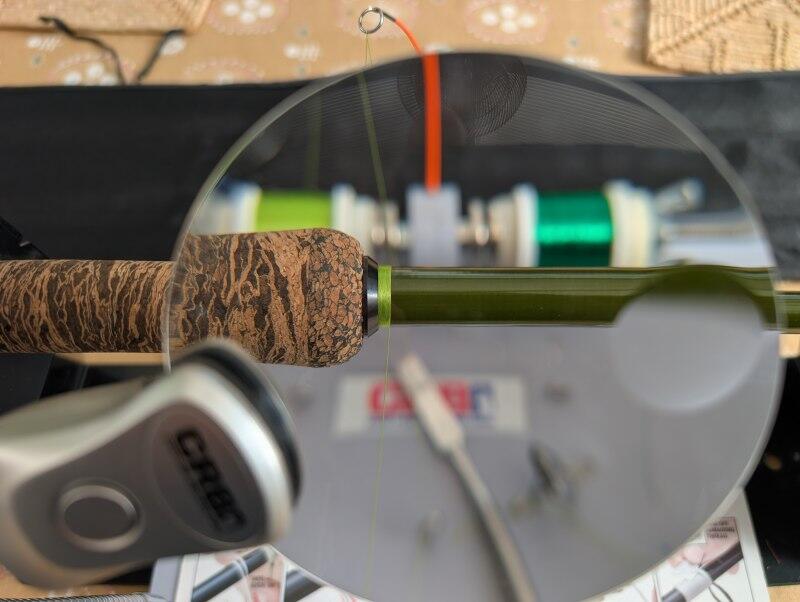
The CRB LED Magnifier for the Advanced Hand Wrapper brings magnification and additional illumination directly to the wrapping area.
Fine fly rod work can involve very small details: starting and finishing threads, narrow trim bands, fine silk or nylon, packing individual turns and inspecting the transition over a guide foot.
Good lighting makes an enormous difference. Magnification makes an even bigger one.
It's useful for the beginner trying to understand exactly what's happening beneath their fingers, and equally useful for the experienced builder chasing increasingly precise wraps.
It also allows you to spot small imperfections before you've applied finish – when they're still easy to correct.
And, for those of us whose close-up eyesight isn't quite what it once was, we'll leave it at that.
Upgrade 4: Magnetic Thread Tension
Once you've become accustomed to the standard wrapper, the CRB magnetic thread tension system is a particularly worthwhile refinement.
The magnets replace the conventional tension springs used on CRB's horizontal thread carriages, providing spool-tension control with an adjustable magnetic system.
For the occasional builder, that means greater control. For someone building rods regularly, it means something even more valuable: repeatability.
Once you've found the tension you like for a particular thread and wrapping style, you want the equipment to behave consistently.
The better your wrapping technique becomes, the more you'll appreciate equipment that simply does the same thing every time you use it.
Upgrade 5: Additional Support Stands
Long fly rod sections can benefit enormously from additional support.
Adding another CRB support stand gives you an additional support point that can be positioned wherever it's required along the blank.
This becomes particularly useful when working with modern 10ft, 10ft 6in and 11ft Euro-nymphing blanks, as well as longer switch and Spey sections.
Allowing too much unsupported blank either side of the wrapping area can make everything feel unnecessarily awkward. Adding another support lets you create a more stable working platform.
Rather than adapting the way you work around the blank, you adapt the bench to suit the rod. That's the way it should be.
Upgrade 6: Four-Spool Thread Carriage
Finally, we have an upgrade that probably isn't essential for the builder producing straightforward single-colour guide wraps – but becomes increasingly useful as your thread work develops.
The standard Advanced Hand Wrapper accommodates two spools, which is more than adequate for the majority of conventional fly rod builds.
The four-spool thread carriage upgrade doubles that capacity, allowing four small-to-medium thread spools to remain mounted and ready to use.
Start adding contrasting trim bands, tipping, underwraps, inlays or more decorative work and its advantages quickly become apparent.
Rather than continually removing one spool and installing another, you can have your principal colours loaded and ready throughout the build.
For a professional builder producing several rods, that convenience can save time. For the more adventurous amateur builder, it gives you a wrapping setup capable of handling increasingly sophisticated thread work.
And that's really the point of the CRB system. You don't need the four-spool carriage when you build your first rod. You may never need it. But if your rod building develops in that direction, your original wrapper is ready to develop with you.
Spares matter too
There's another advantage to using a proper wrapping system that often gets overlooked: replacement parts are available.
We stock replacement items including the slider and tension rod, while CRB also lists individual components for its wrapping equipment.
Being able to replace a component rather than the entire wrapper is exactly what we'd expect from equipment intended for long-term use.
Beginners actually benefit the most
There's sometimes a temptation to think that specialist tools are primarily for experienced rod builders.
An experienced builder can probably produce a decent guide wrap using two cardboard boxes and a telephone directory. Experience compensates for poor equipment. A beginner doesn't yet have that experience.
Give a new builder inconsistent tension, inadequate blank support and an awkward thread path and you've introduced three additional variables while they're simultaneously trying to learn how to wrap a guide.
Give them a stable wrapper with controlled thread tension and suddenly they can concentrate on the important bit: learning the technique.
That can make the difference between a first build that feels frustrating and one that leaves you wondering what you're going to build next.
And experienced builders appreciate consistency
At the other end of the scale, an experienced builder isn't looking for a piece of equipment to teach them how to wrap a guide. They're looking for something that doesn't get in their way. They want repeatable tension, a properly supported blank and thread exactly where they expect it. They want to stop and reverse a wrap without losing control. And when they're building more elaborate rods, they may want several threads loaded and ready to use.
That's why the same relatively simple wrapper can work at both ends of the experience spectrum.
Build the wrapper around the way you build rods
Perhaps the best feature of the CRB Advanced Hand Wrapper isn't any single component. It's the fact that you don't have to decide what your ultimate rod-building bench looks like before you've built your first rod.
Start with the standard Advanced Hand Wrapper. Build some rods. Learn what matters to you. Then add the accessories that improve the way you build.
For the fly rod builder, we'd probably upgrade in this order:
1. Blank Extension Tool – makes wrapping and finishing close to the ferrules of multi-piece blanks considerably easier and can also be used with the CRB RDS Rod Drying System.
2. Tip Support Tool – provides additional control when wrapping fine, flexible tip sections.
3. LED Magnifier – improves visibility and precision when working with fine threads and small guides.
4. Magnetic Thread Tension – offers an adjustable alternative to spring-based spool tension.
5. Additional Support Stands – particularly useful for long, light fly rod sections.
6. Four-Spool Thread Carriage – ideal as your builds progress towards more complex or decorative thread work.
You don't need all six to build a good fly rod. The standard wrapper is already a very capable piece of equipment. The advantage is that you're buying into a modular wrapping system that can develop alongside your rod building.
Start with the wrapper. Add the Blank Extension Tool and Tip Support Tool to deal with the awkward ends of the blank. Add magnification and lighting as you demand greater precision. Upgrade the tension system as consistency becomes increasingly important. Add supports for longer blanks. And, if your thread work develops in that direction, move to the four-spool carriage.
Buy the wrapper you need today, then build the wrapping station you want tomorrow.
The tool we'd rather see you start with
There are certainly cheaper ways of wrapping a fly rod. A cardboard box still works.
But if you're investing in a good blank, carefully selected components and several hours of your own time, we'd argue that the relatively small investment in a proper wrapping system makes a great deal of sense.
The CRB Advanced Hand Wrapper at Fortitude Rod Co gives the first-time builder a better platform on which to learn and gives the experienced builder the control and repeatability needed to produce consistently high-quality work.
Most importantly, it's a tool you can start with, improve and adapt – and potentially still be using many rods later.
From your first guide wrap to your hundredth rod, the principle remains exactly the same: control the thread, control the blank, and concentrate on the quality of the work.
Useful Links
CRB Advanced Wrapper - CRB Advanced Hand Wrapper
CRB AHW Upgrades and Spares - Rod Wrappers and Dryers
Ben O'Neil's Journal Post - The account of a first-time rod-builder by Ben O'Neill